


Last Updated: October 25, 2026
Quick Summary
Home pizza oven accessories include launching peels, turning peels, infrared thermometers, oven brushes, and heat-resistant gloves. The right home pizza oven accessories determine whether you produce restaurant-quality pizzas or struggle with stuck dough and uneven heat. Start with a launching peel, turning peel, and infrared thermometer for around $75 to $115.
- Pizza oven floors need to reach 700 to 900 degrees Fahrenheit for Neapolitan-style pizza and 600 to 700 degrees for American-style pizzas.
- The ElitePeel Sliding Pizza Peel makes launching pizzas easy and helps reduce sticking, while metal peels are durable and excellent for retrieving finished pizzas.
- A pizza turning peel rotates your pizza mid-cook to prevent uneven cooking from heat distribution in most home pizza ovens.
- Beginner setup requires three essentials: a launching peel, turning peel, and infrared thermometer for roughly $75 to $115 total.
- Heat-resistant gloves rated for at least 500 degrees Fahrenheit are essential for safe handling near the oven.
Table of Contents
- Essential Accessories for Home Pizza Oven Success
- Pizza Peel for Home Oven: Launching and Transferring
- Pizza Turning Peel: Rotating During Cooking
- Infrared Thermometer for Pizza Oven Temperature Control
- Pizza Oven Brush and Cleaning Tools
- Dough Preparation and Heat Protection
- Accessory Priorities by Budget and Experience Level
- Choosing Accessories for Your Oven Type and Size
- Frequently Asked Questions
Essential Accessories for Home Pizza Oven Success
Building a home pizza oven transforms your outdoor cooking space, but the oven itself is only half the equation, home pizza oven accessories complete it.
The reality is this: most home cooks underestimate how much technique and the right tools matter. A $500 oven paired with poor technique produces worse pizza than a $2,000 oven with proper accessories and knowledge.
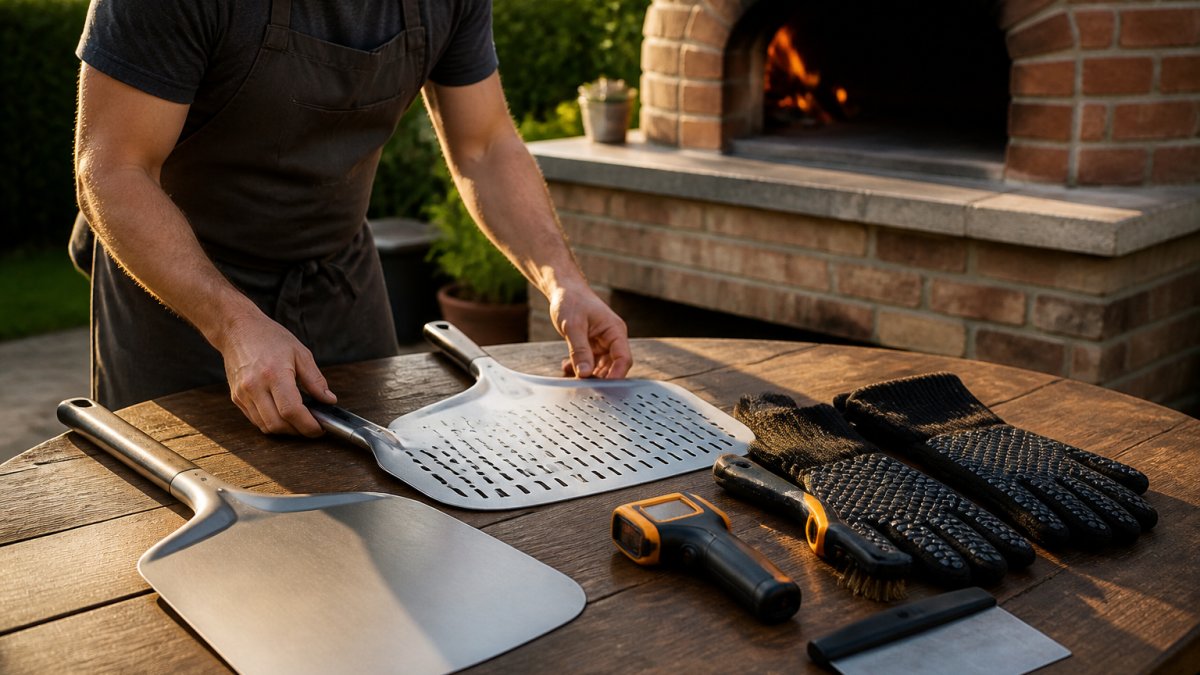
Pizza Peel for Home Oven: Launching and Transferring
The pizza peel is your most critical tool. It's what stands between a perfectly shaped pizza and one that arrives at the oven floor as a collapsed mess. A pizza peel for home oven use isn't just about moving dough, it's about transferring pizza without losing toppings, maintaining shape, and building confidence in your launch.
The peel's job is deceptively simple: slide under raw dough, transfer it to the hot oven floor, and retrieve it when it's done. What makes this difficult is that dough sticks, slides, or tears if your technique or tool isn't right. The wrong peel compounds these problems.
Why We Recommend the ElitePeel for Launching
The ElitePeel Sliding Pizza Peel is built for launching. It's light, easy to control, and eliminates the sticking problem that plags both wood and metal peels, so you get a clean release every time.
Unlike metal peels, which don't absorb moisture and can increase sticking with high-hydration doughs, the ElitePeel's sliding mechanism works regardless of dough hydration or oven temperature.
Our recommendation: use the ElitePeel Sliding Pizza Peel for launching. It ensures your pizza transfers smoothly every time, regardless of dough hydration or oven temperature.
Peel Size and Oven Compatibility
Peel size must match your oven's opening and your pizza size. A peel that's too large won't fit through the oven door. One that's too small forces you to launch multiple pizzas in sections, which is impractical and ruins shape consistency.
Standard home pizza ovens have openings between 24 and 36 inches. Most home cooks work with 12- to 16-inch pizzas, which require peels in the 14- to 18-inch range.
Thickness matters too. Thinner peels (around 1/4 inch) are easier to slide under dough but less durable. Thicker peels (3/8 inch or more) last longer and handle high-heat environments better. For wood, thickness also affects how quickly it absorbs moisture and warps.
Pizza Turning Peel: Rotating During Cooking
Once your pizza hits the oven floor, it needs to rotate. Most home pizza ovens have uneven heat, hotter on one side, cooler on another.
A turning peel is typically smaller and more maneuverable than a launching peel. It's designed to slide under the cooked side of a pizza, lift it slightly, and rotate it 90 to 180 degrees.
Rotation frequency depends on your oven's heat distribution. In very hot ovens, you might rotate every 30 seconds. In more evenly heated ovens, every 60 to 90 seconds is typical. Watch your first few pizzas carefully to learn your oven's behavior.
Infrared Thermometer for Pizza Oven Temperature Control
Temperature control is where most home pizza makers struggle. You can't rely on feel or guessing. An infrared thermometer for pizza oven use gives you exact floor temperature, which directly determines how fast your pizza cooks and how dark your crust gets.
Pizza oven floors need to reach 700 to 900 degrees Fahrenheit for Neapolitan-style pizza and 600 to 700 degrees for thicker, American-style pizzas. Without a thermometer, you're shooting blind.
The Handheld Non-Contact Thermometer For Pizza Oven is designed specifically for this task. It measures surface temperature from 58 to 1,112 degrees Fahrenheit with adjustable emissivity presets, so you get accurate readings on different oven floor materials, stone, brick, or steel.

Pizza Oven Brush and Cleaning Tools
Between pizzas, you need to clear ash and debris from the oven floor. Leftover ash burns onto your next pizza, creating bitter flavors and dark spots. A dedicated oven brush keeps your floor clean and ready for the next launch.
A quality pizza oven brush has stiff bristles (usually brass or steel) that scrape ash without damaging the oven floor. Avoid soft bristles, they won't move ash effectively.
The ElitePeel Oil Brush serves dual purposes. It's designed for oiling your pizza dough before launching, but it also works for light cleaning tasks. For heavier ash removal, a dedicated oven brush with stiffer bristles is your primary tool.

Dough Preparation and Heat Protection
Pizza success starts before the oven. Proper dough preparation, accurate measurements, and safe handling make the difference between amateur and professional results.
Scales, Bench Scrapers, and Prep Surfaces
Precision in dough weight is non-negotiable. A digital scale ensures your dough balls are consistent, which means consistent cooking times and results. Most home pizza recipes work with dough balls between 250 and 350 grams, depending on pizza size and thickness.
A bench scraper (also called a dough scraper) is essential for handling high-hydration doughs. These sticky, wet doughs are difficult to work with. The ElitePeel Pizza Dough Scraper is designed specifically for this.
A prep surface matters too. Marble or granite stays cool and reduces sticking. Stainless steel is durable and easy to clean. Avoid wooden surfaces for dough prep, they absorb moisture and become breeding grounds for bacteria over time.
Heat-Resistant Gloves and Safe Handling
Pizza ovens reach extreme temperatures. Your hands need protection. Heat-resistant gloves rated for at least 500 degrees Fahrenheit are essential. Silicone gloves work well and are easy to clean. Leather gloves offer better dexterity but require more maintenance.
Handheld Non-Contact Thermometer For Pizza Oven, Grill →
Never reach into a hot oven without gloves. The risk of serious burns is real. Keep your gloves accessible near the oven so you're never tempted to work without them. Many pizza makers keep two pairs, one for launching and one for retrieving, so you always have a clean pair ready.
Accessory Priorities by Budget and Experience Level
Your budget and experience determine which accessories matter most right now. We've organized three setups: beginner, intermediate, and complete. Start with what matches your situation and upgrade as you develop skills and confidence.
Beginner Setup
Start with three essentials: a launching peel, a turning peel, and an infrared thermometer. These three tools solve the biggest problems beginners face, launching without disaster, rotating for even cooking, and controlling temperature.
The ElitePeel Sliding Pizza Peel costs $25 to $50. A metal turning peel runs $15 to $30. An infrared thermometer like ours is $34.99. Total investment: roughly $75 to $115. This covers the fundamentals. You can make excellent pizza with just these three tools.
Skip the fancy accessories for now. You don't need a complete tool kit. You need the tools that directly impact pizza quality. Oven brushes, dough scales, and gloves matter, but they're secondary to launch, rotation, and temperature control.
Intermediate Setup
Once you've made 20 to 30 pizzas and understand your oven's behavior, add four more tools: a quality oven brush, a digital scale, heat-resistant gloves, and a bench scraper.
The oven brush ($20 to $40) keeps your floor clean between pizzas. The digital scale ($15 to $40) ensures consistent dough weights. Heat-resistant gloves ($15 to $30) protect your hands and give you confidence working near the oven.
At this level, you're refining technique and building consistency. These additions directly support that goal. Total additional investment: $60 to $130. Your total toolkit is now around $140 to $245, and you have everything most home pizza makers need.
Complete Setup
The ElitePeel Sliding Pizza Peel Replacement Tarps are $17.99 each. An oven cover runs $40 to $100. A pizza stone or steel can range from $30 to $150 depending on material and size.
At this level, you're not just making pizza, you're optimizing every step. You have redundancy (backup peels), protection (oven cover), and specialized tools for specific tasks. This setup supports hosting regular pizza nights and experimenting with different styles and doughs.
These three setups show which accessories to prioritize based on your experience and budget.
| Setup Level | Essential Tools | Cost Range | When to Use |
|---|---|---|---|
| Beginner | Launching peel, turning peel, infrared thermometer | $75-$115 | First 20-30 pizzas |
| Intermediate | Add oven brush, digital scale, heat-resistant gloves, bench scraper | $60-$130 additional | After mastering basics |
| Complete | Add second peel, pizza stone or steel, oven cover, replacement tarps | $250-$500 total | Regular hosting and experimentation |
Choosing Accessories for Your Oven Type and Size
Oven type and size dramatically affect which accessories work best.
Wood-fired ovens reach the highest temperatures (800 to 900+ degrees Fahrenheit) and have the most dramatic heat variation.
Gas ovens maintain more consistent temperature and reach 700 to 800 degrees Fahrenheit reliably.
Indoor ovens (countertop or built-in) operate at lower temperatures, typically 500 to 600 degrees Fahrenheit.
Oven size affects peel choice. Larger ovens (36+ inches) accommodate bigger peels and larger pizzas.
The fundamental accessories, launching peel, turning peel, thermometer, work across all oven types.
Building a successful home pizza oven setup doesn't require spending hundreds of dollars at once.
We recommend beginning with a launching peel, turning peel, and infrared thermometer.
Frequently Asked Questions
What is the difference between a launching peel and a turning peel?
A launching peel transfers raw dough onto the oven floor with minimal disturbance, typically featuring a wide, flat surface and lower friction. A turning peel is smaller, more maneuverable, and designed to rotate pizzas mid-cook for even heat exposure. Most home cooks benefit from having both, though beginners can start with a quality launching peel alone.
Do I need an infrared thermometer for pizza oven temperature management?
An infrared thermometer for pizza oven use measures surface temperature without contact, helping you confirm your cooking floor has reached the optimal 700-900°F range for Neapolitan-style pizza or 500-600°F for thicker crusts. While not strictly required, it removes guesswork and prevents undercooked or burnt results. A handheld non-contact model like the ElitePeel thermometer ($34.99) reads from 58-1112°F and adjusts for different surfaces.
Will a pizza peel for home oven work with both wood-fired and gas ovens?
Yes, most peels work across fuel types because the launch and rotation techniques remain the same. However, wood-fired ovens often run hotter and require more aggressive heat management, so choosing a peel with excellent non-stick properties and heat resistance is critical. Verify your peel's maximum temperature rating matches your oven's typical operating range.
What size pizza peel should I get for my oven?
Peel diameter should be slightly smaller than your oven's interior width to allow clearance when inserting and rotating pizzas. For most home ovens (24-36 inches), a 12-14 inch launching peel works well. Measure your oven opening and account for the oven's dome curve; when in doubt, go one size smaller to ensure smooth maneuvering without scraping the edges.
How do I prevent toppings from shifting when launching pizza?
A non-stick, low-friction surface is essential, this is where a quality launching peel makes the difference. Before loading dough, dust the peel lightly with semolina or flour. Keep toppings away from the peel's edges, place heavier toppings toward the center, and use a confident, smooth motion when transferring. High-hydration doughs benefit most from peels with superior non-stick coatings.
Are pizza oven accessory kits worth buying, or should I buy tools individually?
Kits offer convenience and cost savings if they include tools you'll actually use. However, quality varies widely, and bundled items may not match your specific oven type or cooking style. Buying individually lets you prioritize essentials first, a launching peel and thermometer, then add specialized tools like a turning peel or brush as your skills grow.
