


Last Updated: November 1, 2026
Quick Summary
Specialized pizza tools pay off because they fix the step where home pizza usually fails: moving the dough. A sliding peel keeps toppings in place during the launch, and a cutter and thermometer cover slicing and oven readiness. Compare each tool's cost against how often it prevents a failed bake.
- A sliding peel helps keep toppings in place during the launch.
- Measure your oven opening before buying a peel, since an oversized peel makes the launch harder.
- The ElitePeel pizza cutting wheel is listed at $9.99.
- The handheld non-contact thermometer is listed at $34.99 and reads 50 to 600 degrees Celsius.
- Divide a tool's price by realistic lifespan to estimate its cost per pizza.
Table of Contents
- Why Home Pizza Goes Wrong Without the Right Tools
- Best Pizza Peel for Home Oven: What Actually Matters at the Launch
- Essential Accessories for Home Pizza Oven Cooking
- Pizza-Making Tools for Beginners: Where to Start
- Building a Pizza Oven Accessory Kit Without Overspending
- Cost Per Pizza: Does Specialized Equipment Pay Off Over Time?
- Choosing Your First Upgrade and Testing It on Your Next Pizza Night
- Frequently Asked Questions
Why Home Pizza Goes Wrong Without the Right Tools
Home pizza usually fails at the same point: the moment you try to move the dough. A pizza that is perfectly topped on the counter can stick, tear, or slide into a pile of cheese and sauce the second it meets the oven floor. This problem is common enough that it shapes how many home cooks think about the whole process.
The frustrating part is that the failure is rarely about skill alone. A flat, improvised spatula often cannot slide under a loaded pie without disturbing the toppings. Dough that is high in hydration makes the problem worse, because it clings to every surface it touches. The result is a crust that is misshapen before it ever sees the heat.
Specialized tools separate the jobs you are asking one utensil to do. A launching peel handles transfer, a cutter handles slicing, and a thermometer tells you whether the oven is actually ready.
Best Pizza Peel for Home Oven: What Actually Matters at the Launch
A home cook sliding a topped pizza off a wooden peel onto a stone in a home oven is the moment this section is about. Choosing a peel comes down to whether it lets the pizza slide cleanly from the surface to the oven floor. Thickness, handle length, and surface material all affect how confidently you can make that move, especially when the oven is hot and your hands are working quickly.
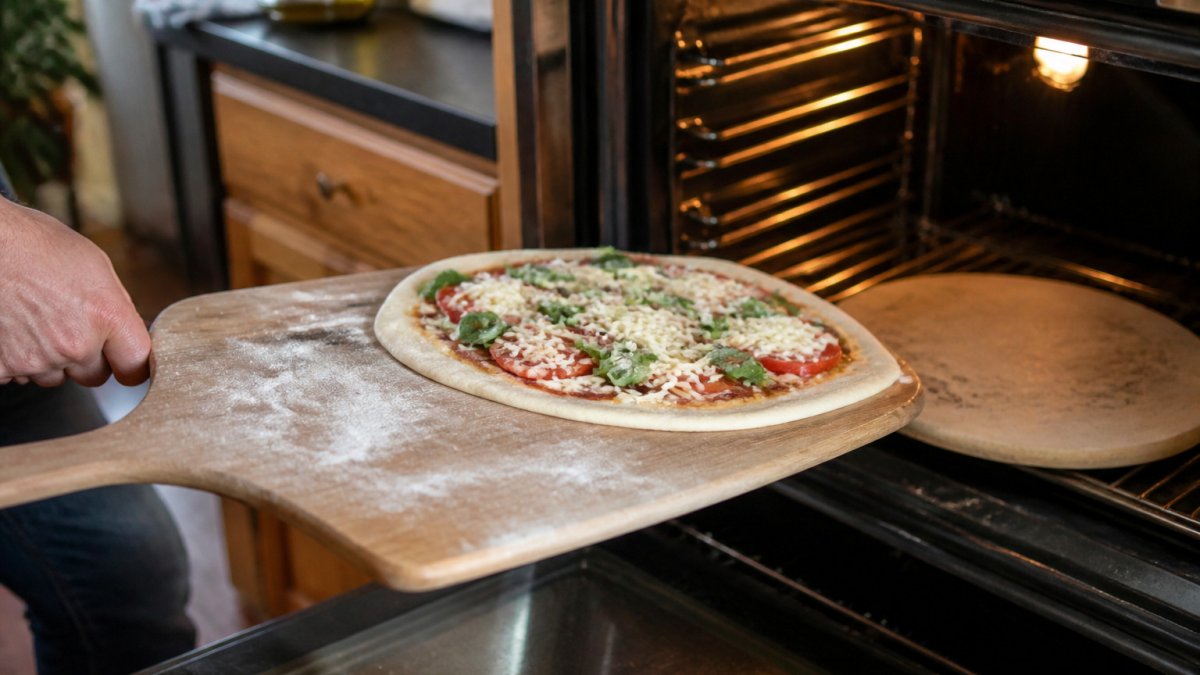
Look for a peel whose blade is thin enough to slip under the dough without lifting the toppings. A thick, rounded edge tends to drag, which is where cheese shifts and crusts deform. Handle length matters just as much, because a short handle places your hand too close to an oven that can exceed several hundred degrees.
A common mistake is buying a peel that is too large for your oven opening. Measure the space before you order, since a peel that cannot enter the oven cleanly makes the launch harder, not easier.
Why a Sliding Peel Keeps Toppings in Place
A sliding peel is designed to address the problem of toppings shifting during the launch. Its surface is intended to let the pizza move with less friction, so the toppings can stay where you placed them while the dough transfers.
The practical difference shows up during the transfer. A sliding design is intended to reduce the shaking needed to free the dough, which helps keep the pie looking like the one you assembled.
Tarps, Replacement Parts and Long-Term Upkeep
Replacement parts are part of the cost of ownership, and they deserve attention before you buy. The ElitePeel sliding pizza peel replacement tarps are listed at $17.99.
Essential Accessories for Home Pizza Oven Cooking
Beyond the peel, a few accessories cover the other steps where home pizza typically goes wrong. A cutter helps you slice the pie. The ElitePeel pizza cutting wheel is listed at $9.99 and is designed to slice with more control than a conventional wheel cutter with a handle. You can see and buy the ElitePeel pizza cutting wheel here. The ElitePeel stainless steel cutting wheel and oil brush is listed at $14.99 and pairs cutting with crust oiling.

Oven temperature is the other variable that is easy to guess and hard to get right. The handheld non-contact thermometer for pizza ovens and grills is listed at $34.99 and measures temperature from 50 to 600 degrees Celsius, or 58 to 1112 degrees Fahrenheit. You can check the handheld thermometer's details and order it to read your oven surface.

The ElitePeel oil brush is listed at $9.99 and is designed for oiling grills and spreading olive oil on pizza dough.
Pizza-Making Tools for Beginners: Where to Start
Beginners do not need a full kitchen of gadgets, but they do need a way to tell which tools are essential, which are optional, and which only make sense for a specific pizza style. A tiered buying guide prevents the two most common mistakes: overspending on tools you will rarely use, and underspending on the one tool that fixes your biggest problem.
Tier 1, Essential for almost everyone. These tools solve problems nearly every home baker hits:
- A peel (launching or sliding). The launch is where many home pizzas run into trouble, so a peel is a useful first purchase.
- A cutter. Useful for slicing the pie. A stainless option with an oil brush pairs cutting with crust oiling.
- An infrared thermometer. A handheld non-contact thermometer can read surface temperature, which helps you check whether the stone is hot before you launch.
Tier 2, Optional, buy once you bake often. These improve consistency but are not required to start:
- An oil brush. Useful for flavor and for keeping crust from sticking, but pouring and spreading by hand works in a pinch.
- A bench scraper and dough cutter. Helpful for dividing dough and cleaning the counter, but a knife and a steady hand cover most of the same ground.
- A second peel. Convenient for turning and retrieving, but not essential until you are baking multiple pies per session.
Tier 3, Style-specific, skip unless you bake that style. These only earn their place if you commit to a particular approach:
ElitePeel Pizza Cutting Wheel →
- A pizza steel. Excellent for home-oven Neapolitan-style and New York-style bakes, but heavy and unnecessary if you already have a dedicated pizza oven.
- A perforated pan. Useful for pan pizza and for beginners who struggle with launching, but it produces a different crust than a stone or steel.
- A turning peel. Worth it for high-volume bakes in a dedicated oven, overkill for a single home pie.
Avoid buying everything at once. Bake a few pizzas with your current setup, note where it fails, and let that failure guide your next purchase. This approach keeps spending tied to a real problem rather than a guess about what you might need. A thermometer reading indicates the surface temperature of the stone or floor, not the air around the pizza.
Building a Pizza Oven Accessory Kit Without Overspending
A useful pizza oven accessory kit covers the launch, the cut, and the temperature check, and nothing more. Start with a sliding peel, add a cutter, and then add a thermometer if you bake often enough to benefit from it. The oil brush is optional and mainly useful if you care about crust flavor.
Compare the cost of each piece against how often you will use it. A cutter used at every pizza night earns its price faster than a specialty accessory used once a month. For a household that hosts pizza nights regularly, the cutter and peel are usually the highest-return pair.
Skip accessories whose function duplicates something you already own. If a standard knife cuts cleanly for you, a wheel cutter may be a refinement rather than a necessity.
Cost Per Pizza: Does Specialized Equipment Pay Off Over Time?
Cost per pizza is one way to judge whether specialized tools are worth it. A useful framework has four inputs: upfront price, expected lifespan, failure cost avoided, and replacement parts.
1. Upfront price divided by realistic lifespan. Divide the price of a tool by the number of pizzas you expect it to serve before it wears out or needs replacing.
2. Failure cost avoided. The math works best when a tool prevents a failed pizza. One ruined pie costs the ingredients, the time, and the disappointment of guests.
3. Replacement parts as a cost line, not an afterthought. Replacement costs belong in the calculation too.
4. Durability and material quality. A tool that lasts five years at $40 beats a $20 tool that needs replacing every year.
Run the four inputs for any tool you are considering, and the answer usually becomes obvious. The goal is not the cheapest kit, it is the shortest list of tools that each earn their place across years of pizza nights.
The four inputs below turn the payoff question into concrete numbers, with the prices and examples the article gives.
| Input | What to estimate | Example from the article |
|---|---|---|
| Upfront price ÷ lifespan | Price spread over expected pizzas | $34.99 thermometer over 50 bakes ≈ 70 cents per pizza |
| Failure cost avoided | Ruined pies the tool prevents | Stuck or torn dough ruins a bake |
| Replacement parts | Recurring cost to keep the tool working | Tarp listed at $17.99 |
| Durability and material | Lifespan versus sticker price | Stainless and anodized outlast thin stamped metal |
Choosing Your First Upgrade and Testing It on Your Next Pizza Night
Your first upgrade should target the step that fails most often. If your pizzas stick or slide during the launch, start with the sliding peel. If the crust is inconsistent, start with the thermometer so you can see whether the stone is hot enough.
Test the new tool on your next pizza night with a plain margherita, which makes problems easy to see. Note whether the launch was clean, whether the cut was even, and whether the crust set as expected. That single test tells you more than any product description.
Once the first upgrade works, you can decide whether the next step is worth the cost. The goal is a short list of tools that each solve a problem you have actually experienced, not a drawer full of gadgets you rarely use.
Frequently Asked Questions
What tools do you need to make pizza at home?
At minimum you need a way to launch and retrieve the pizza, a surface that holds high heat, and a cutter. A pizza peel handles the launch, a pizza stone or baking steel stores heat for a crisp base, and a rocker or wheel cutter finishes the job. A dough scraper helps with handling and an infrared thermometer lets you confirm the cooking surface is hot enough before the pizza goes in. Start with the launch tool and the heat surface, since those two decide whether the pizza arrives intact and bakes evenly. Everything else is refinement.
Are specialized pizza tools worth the investment?
They are worth it when a tool solves a problem you hit regularly. The ElitePeel sliding pizza peel is designed for flawless launches. Its price is not listed in this article. Replacement tarps at $17.99 and the optional 5-year warranty at $15.00 extend the useful life. If you cook once a year, a basic peel is enough. If you host pizza nights every few weeks, a dedicated launch tool usually pays off in saved dough and fewer ruined pies.
Do you need a turning peel for a home pizza oven?
A turning peel is useful but not required for most home ovens. It lets you rotate a pizza partway through baking so the crust colors evenly, which matters in ovens with hot spots. Many home cooks rotate by hand with a pair of long tongs or the peel itself. If you notice one side of your pizzas consistently browning faster, a turning tool is worth adding. Check your oven's heat pattern first, since a turning tool only solves uneven baking, not a launch problem.
What tools help prevent pizza dough from sticking to a peel?
Sticking usually comes from insufficient semolina or flour on the peel, dough that is too wet, or a launch surface that is not hot enough. The ElitePeel sliding pizza peel uses a high-temperature non-stick tarp, and replacement tarps are listed at $17.99. A dough scraper helps you lift dough without tearing it, and an infrared thermometer confirms the stone is at cooking temperature before launch. Dusting with coarse semolina rather than fine flour also helps, since it acts like small ball bearings beneath the dough.
